
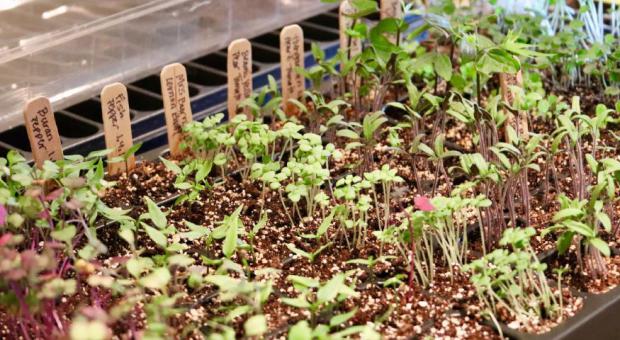
Photo by Jill Dunbar/22nd Century Media
By Margaret Tazioli
GLENCOE, IL — The idea for the annual seed exchange at the Chicago Botanic Garden first came to Kristie Webber through a newspaper clipping a friend shared with her. “I hadn’t heard of a [seed exchange] before, but you know how it’s funny, the minute one person tells you, you suddenly see it everywhere,” Webber said, the director of interpretive programs at the Chicago Botanic Garden.
So, Kristie Webber began organizing a seed exchange for the Chicago Botanic Garden. The event now takes place in January, between the holiday train exhibit and the orchid show every year.
The seed exchange has been so popular that Webber made a whole weekend out of it January 27 and 28 this year with speakers and activities on both days.
The culminating event, the seed exchange itself, was stocked with donations from seed companies.
The Federal Seed Act of 2000 requires seeds to be sold within two years of packaging. According to Webber, seed companies are usually willing to give any seeds not sold before that expiration date to community gardens and seed exchanges.
“The world can be so impersonal and a little fractious now. People may be a bit on edge for a variety of reasons, but there’s something that’s just hope in a seed,” Webber said. “You have your seed starting mix, you put your little light on and a heat mat, and then within five days or so, you start to see that little green sprout and it’s just so exciting. It doesn’t lose that sparkle.”
For beginning seed savers, there were plenty of lettuce, tomato, radish, pumpkin, bean, carrot, and flower seeds to choose from at the exchange.
For more seasoned seed savers, people who already collect and store their own lettuce and tomatoes and more, the connoisseur corner is the place to go.
There, a couple of veteran garden volunteers bring their own stock of specialty seeds to trade.
One of those volunteers, longtime Glencoe resident Larry Aronson, has a passion for peppers. At the table in front of him were small packets of pepper seeds from all over the world. Some of his seeds were ají dulce from Venezuela, chile fresno from California, espelette from France, and chile de agua from Oaxaca.
Aronson’s passion for pepper extends beyond the garden. He cooks with it and argues it’s an essential ingredient for most dishes.
“I just enjoy it, I’ve been studying it for about 45 years,” Aronson said. “It’s one of the main components of taste in food. If you want a great meal, you’ve got to use peppers. Cooking without peppers is like painting without blue.”
Not all peppers are hot according to Aronson. The Ají dulce from Venezuela is a sweet habanero with no heat.
Besides the connoisseur table at the seed exchange, Aronson has a pepper cart from which he teaches people in the Chicago Botanic Garden’s vegetable garden every summer.
Volunteers in the vegetable garden also grow and give away small plants as well as assist with events at the Chicago Botanic Garden all year long.
The garden’s seed library is also a good place to “borrow” some starter seeds.
People can get seeds from the garden and then start saving seeds from the resulting plants. One woman Webber met did just that. “Every year she brings her seed back and every year, at the heirloom fest in August, she brings us a whole tray of tomatoes she’s grown from the seed from here.”
Originally published in the Glencoe Anchor on January 31, 2018.
 margarettazioli.com