
By Margaret Tazioli
HOUSTON, TX — Tunneling_CaseStudy_Jan19
Tunneling without digging a trench is hard enough. But then, try excavating a 28-foot tunnel under a busy road with less than 7 feet of cover for a high profile client. Not to mention the tunnel is curvilinear and telescoping in size.
McCarthy Building Companies contracted AR Daniel Construction Services for this very task at the Museum of Fine Arts, Houston. The project’s primary architect, Steven Holl, asked for a pedestrian tunnel to connect the existing Caroline Wiess Law Building to the planned Kinder Building. Excavating the tunnel was up to AR Daniel Construction Services and a partner artist will complete the interior of the tunnel next year.
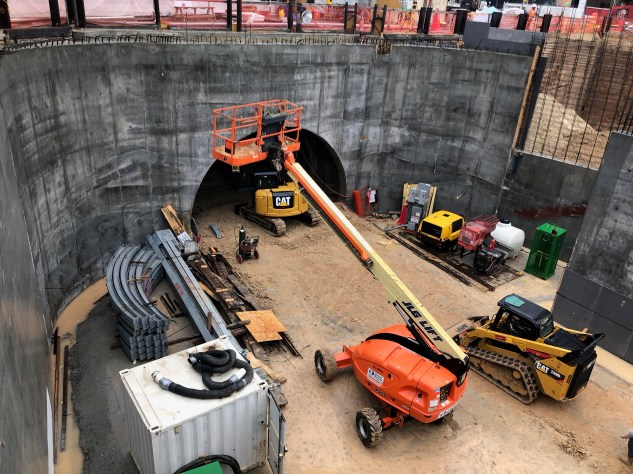
In order to connect the exterior wall of the law building with the under construction-Kinder Building’s basement, the pedestrian tunnel had to go under Bissonnet Street. Due to the congestion of the street and the old oak trees lining it, the project required a trenchless tunnel excavation.
An Unusual Size
Besides the necessity of ground support and set floor elevations on both ends, the project’s designers at Steven Holl Architects and Kendall/Heaton Associates required the tunnel have an outside diameter of 28-feet, 6-inches.
This was a very large tunnel according to Art Daniel, President and COO of AR Daniel Construction Services. The average size tunnel AR Daniel excavates is typically closer to 6 feet.
“The lack of cover was the greatest challenge, magnified by the size of the tunnel,” Art Daniel said. “The height of cover never exceeded 7 feet and decreased to as little as 7 inches.”
The lack of cover meant more of the vertical load would come to bear on the tunnel excavation rather than spread outward away from the tunnel according to Art Daniel.
The minimum standard in tunneling for height of cover is one and a half times the diameter of the tunnel. In this case, one and a half times a 28-foot, 6-inch-diameter would have been 42 feet, 9 inches of cover, six times more than what was available.
Unexpected Utilities
If a tunnel is 40 feet underground, there isn’t much in the way. But with less than a foot between the top of the tunnel and the ground surface in some places, the crew ran into a lot of utility lines.
At one point, Project Manager Bryan Daniel, Art’s son, said he counted eight unknown utility lines they came across while digging.
“Some lines we were able to just push up and get above the tunnel,” Bryan Daniel said. “Some of them, we had to cut holes in the liner plate to be able to keep going and come back later and work with the utility companies to get them lifted up out of the way and reassemble the tunnel in that section.”
A Focus on Forepoling
Besides navigating around utility lines, AR Daniel also had to contend with a high risk of ground settlement due to the lack of cover.
Art Daniel said they researched new ground stabilization techniques such as ground freezing and different types of grouting, but rejected these options for technical reasons or because of potential damage to the trees’ root systems.
Instead, AR Daniel chose to modernize forepoling, a traditional soft ground tunneling method that requires shooting rebar forward to help hold up the ground as the crew excavates underneath it.
The project’s Foreman Pablo Garcia decided to adapt a clay spade, a pneumatic hammer with a shovel attached, to drive the rebar. Garcia removed the shovel and used its pneumatic hammer to drive the rebar forward into the ground a lot faster. This allowed the excavation crew to install five rods in the same time it would have taken to install one with a sledge hammer.
“When we would complete a ring of liner plate, we would then do the forepoling into the next ring or two with rebar that was 5 feet long,” Bryan Daniel said. “And then we would use the excavator to excavate most of the dirt around the edges where we had previously driven rebar for forepoling.”
To avoid over-excavating, Garcia placed a special-made cutting tooth on the excavator and any over-excavation was filled in right away with grout outside the tunnel liner. The crew used a newly developed urethane filler to seal the seams of the sectional liner plate thus keeping the grout where it needed to be in the voids behind the support system instead of leaking through the seams of the tunnel.
The key to keeping the ground stable with this method was working at a slower pace overall and limiting the ground exposed to settlement by moving forward in very small chunks.
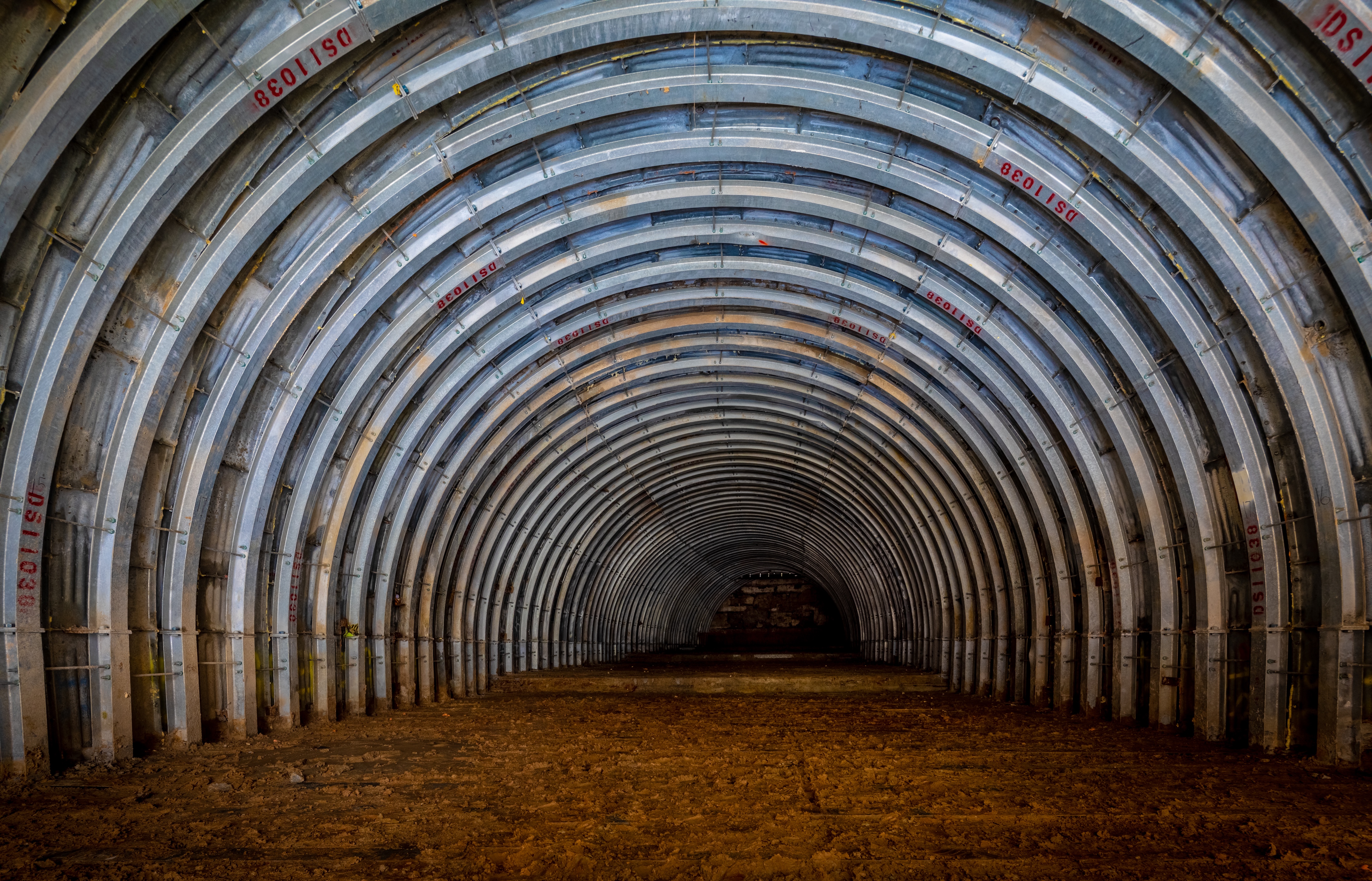
“The support system we installed, tunnel liner plate, is a sectional plate that bolts together to form the shape of the tunnel,” Art Daniel said. “Each plate is 16 inches wide and 36 inches long. We would only excavate forward of the last support system enough distance to install one plate at the top of the shape, then move left and right from the top excavating for and installing additional plates until the complete ring had been assembled.”
Starting out, Project Manager Bryan Daniel said he had some concerns about supporting the dirt above the tunnel as they were excavating. “One of the things I learned though is that through forepoling and small cuts at a time, you’re really able to make sure that the ground above will hold when you take the proper steps. I mean, I knew that, but seeing it in action is a big confirmation of the theory.”
Published in Texas Contractor, January 2019
 margarettazioli.com